Small Business Gift Packaging: Beautiful Presentation Without Losing Track of Costs
Updated: 1 day ago
A ribbon, a good box and a thoughtful finishing touch can make a small-business order feel ready to give. But when you are preparing candles, soap, tea, jewelry or holiday gifts, every layer also uses materials, space and time.
The goal is packaging you can repeat at a cost you understand. Start with the look you want, calculate what one complete order costs, and check the result before you buy supplies for the season.
Beautiful packaging starts with knowing your costs.
Before buying boxes and ribbons in bulk, plan what one finished order will cost. Our free Excel planner helps you include packaging alongside materials, your time and selling fees, then compare your selling price with your costs. Includes a Price Planner and First Batch worksheet; Microsoft Excel is required.

Three gift packaging ideas you can adapt to your business
1. Soft and gift-ready: pair a plain box with blush tissue and one generous ribbon. Let the color and texture do the work. For candles or soap, keep the product label easy to find and choose protection suited to the item. Start with one sample before committing to a large supply order.

2. Rich holiday color: use a neutral box with forest-green ribbon and a simple tag. A consistent ribbon color can tie different products into one collection without requiring a different printed box for every item. Price the ribbon by the amount used on each finished package.

3. Simple everyday packaging: use one suitable box or bag, one branded label and a short thank-you card. Keep the base packaging useful beyond Christmas and add a removable seasonal detail where it makes sense. Fewer components can make stock counting and packing easier; test whether the finished result still protects and presents the product well.
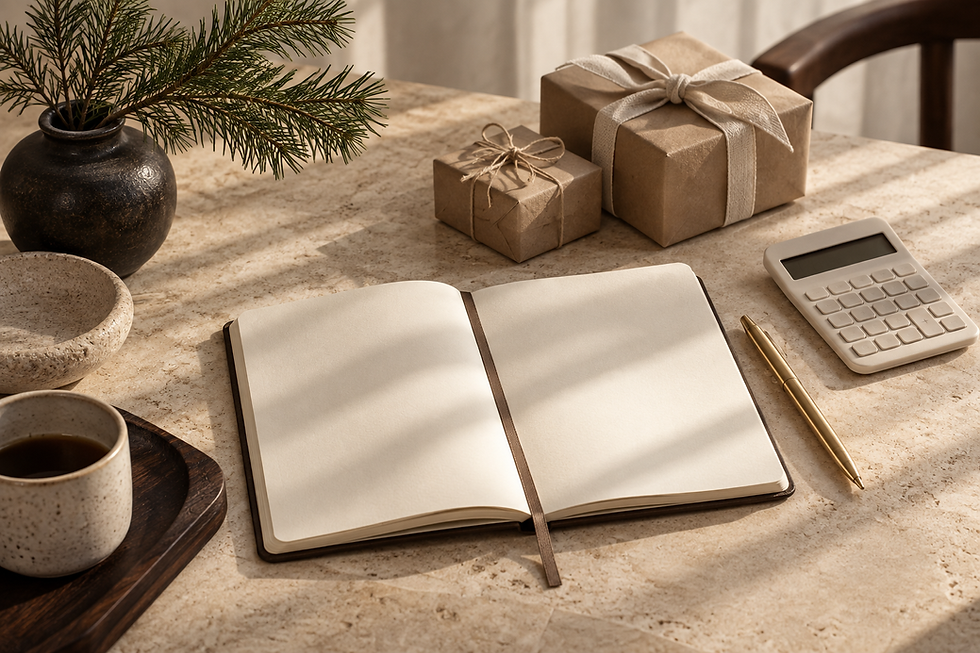
These images are AI-generated styling concepts. They illustrate presentation ideas; LorenBrooke sells planning tools, not the physical products or packaging shown.
How much does your packaging cost per order?
Calculate the materials used for one complete order. Do not stop at the price of the empty box. A supplier pack price also needs converting into a usable per-item cost.
Box, bag or mailer.
Tissue, protective inserts or wrapping.
Ribbon, labels, tags and cards.
An allowance based on your own experience for damaged or unusable supplies.
Packing time, if you want that labor included in your planning cost.
For example, a $30 pack of 100 usable labels costs $0.30 per label before any additional supplier delivery charges or taxes. If an order uses two labels, that order uses $0.60 of labels. Allocate relevant supply delivery costs consistently rather than counting the same expense twice.
For gift sets, count the shared outer packaging once, then add the individual wrapping that each item actually needs. A one-item order and a four-item gift box may need different cost assumptions.
A worked example: what happens when you offer 20% off?
The following figures are illustrative assumptions, not recommended prices or industry benchmarks. Imagine one gift product with an original selling price of $28.
Finished product cost: $10 per unit, already including its manufacturing cost.
Gift packaging: $3 per unit.
Packing labor allowance: $2 per unit.
Combined planning cost: $10 + $3 + $2 = $15 per unit.
At full price, $28 − $15 leaves $13 per unit after those listed costs. At 20% off, the dollar discount is $5.60 and the selling price becomes $22.40. Then $22.40 − $15 leaves $7.40 per unit.
The discount reduces the amount remaining by $5.60 on every unit sold. Across 50 units, that is $280 less remaining before other expenses, assuming the same unit costs and no change in volume.
This is not your final business net profit. Payment fees, any seller-funded customer shipping, event fees, rent and other overhead have not been included in this example. A price that covers these three inputs can still leave the overall business losing money.
Use the Markdown & Margin Calculator to test the choice
For this example, enter $28 as the original selling price, $15 as the combined unit-cost input, and 20% in Discount %. The calculator displays the dollar discount, resulting selling price and estimated per-unit profit or loss from your entered costs. Try another discount percentage to compare the outcome before choosing a promotion.
The calculator does not automatically collect your packaging costs or calculate percentage-based payment fees. Add the relevant fixed per-unit costs yourself, avoid double counting, and review other expenses separately. It is a paid Excel download; Excel is not included.
Beautiful packaging also needs a workable packing routine
Make a small representative batch before your busiest week. Record how long it takes, which materials run out first and whether the package fits its intended handover or shipping method. A decorative finish that takes much longer than expected may change your labor allowance.
Keep frequently used materials within reach of the packing surface.
Prepare only the quantities you can store and expect to use.
Choose box sizes around the actual products, including protective materials.
Separate everyday supplies from seasonal extras so both are easy to count.
Test a simpler version alongside the decorative version before choosing your standard.
Reducing packing time does not mean rushing or removing necessary protection. Look first for repeated searching, unnecessary steps or too many packaging variations.
What should you review each week during the holidays?
Compare planned orders with actual orders, packaging bought with packaging used, and estimated packing time with the time the work actually took. Record damaged packages, customer comments and leftover seasonal supplies.
Then choose one change for the following week: adjust the supply order, simplify a ribbon treatment, revise a cost input or retest a proposed discount. Keep the change specific enough that you can see whether it helped.
If you are still deciding how much product to bring to a holiday market, start with the inventory planning guide. Packaging quantities should follow a realistic selling plan, with a clearly chosen buffer, rather than the excitement of a bulk discount.
Your takeaway: cost one complete order before buying in bulk
Choose one product, make one finished package, and list everything it used. Add any packing labor you want included in your planning cost. Test your intended selling price and discount against that cost, then review the expenses that remain outside the calculation.
You can keep the beautiful presentation. Give it a clear cost and a repeatable process, so it supports the business you are building.

Comments